Credits, Rewards and Competition: How the Ancient Duel Economy Works
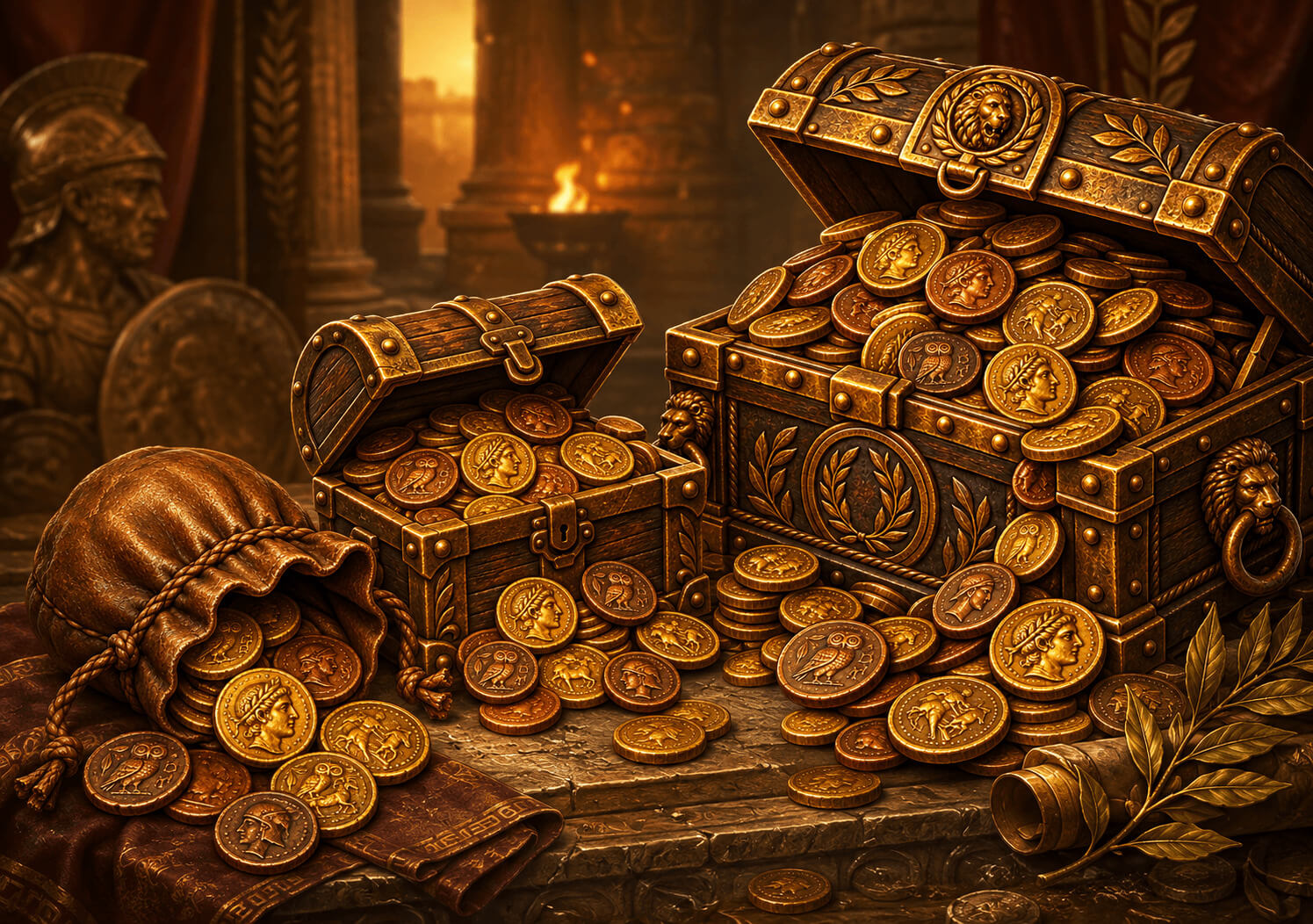
There is a new number in Ancient Duel. It sits in the account badge, it is labelled Credits, and if you open it you can read every Credit you have ever earned or spent, one line at a time, newest first.
A currency is the kind of feature that has earned suspicion. Players have seen enough games where a points balance turned out to be the opening move of something they did not sign up for, and I would rather nobody had to reverse-engineer my intentions from a balance and three buttons in a shop. So this article is the whole economy, explained before anyone has to ask: what Credits are, where they come from, what they buy, what they can never buy, and why the rules were written down this early.
What a Credit is, and what it is not allowed to be
A Credit is a reward resource attached to your account. It exists so that competitive play can produce something that lasts longer than the match that earned it, and it unlocks things that sit around the game rather than inside it.
The shop page carries two sentences that are the closest thing the system has to a constitution. The first: Credits unlock tournaments and printable decks. They never buy in-match power. The second: Credits are game currency. They cannot be exchanged for money. Everything else in this article is those two sentences, unpacked.
Competition should produce more than a number
Ranked already answers two questions. Your rating answers "how well am I playing?". The leaderboard answers "where do I stand?". Both are honest answers, and neither of them persists in a useful way: a rating drifts, a position gets overtaken, and a good competitive run leaves nothing behind except the memory of it.
Rewards add a third answer: "what did this run produce?" That question matters more now than it did a few months ago, because the road into Ranked was recently shortened so that players reach real competition sooner. Getting people to the ladder faster is only half the work. The other half is making sure the ladder leads somewhere — position, recognition, progression, and something you keep.
A win already carries its own satisfaction. The satisfaction resets to zero when the next duel starts. A Credit does not, and that small persistence is the entire design idea.
How Credits are earned
There are exactly three ways to earn Credits by playing, and I would rather list them precisely than gesture at "various rewards".
A ranked victory pays Credits. Only a genuine ranked match counts — practice duels, private matches and campaign missions pay nothing, and matches inside a tournament are paid on placement instead, not per win. Only a victory pays: a draw pays neither player. A win by surrender does count, because the alternative is a system that argues with players about which victories were earned enough. The amount is deliberately small — a trickle, not a wage. Enough that a long climb through Ranked leaves a visible residue, never enough that anyone should play a match for the payout rather than for the match.
Reward milestones pay out as achievements accumulate. A series of thresholds runs from your first handful of achievements to the far end of the list, each paying more than the one before it, because the later ones are much harder to reach. Every threshold is paid once per account, ever, and the total across all of them is capped by design. They exist so that progress through the game itself, not only through the ladder, shows up in the balance. You can even start collecting them before you have a full account: milestone Credits earned as a guest are kept when you sign up, and signing up never pays the same milestone twice.
Tournament placements pay Credits. How that works is in the next section, because tournaments deserve their own.
That list is complete. There are no daily login bonuses, no streaks, no quests, no watching of advertisements. If a fourth source of Credits ever appears, it will be announced, not discovered.
Two kinds of prize in a tournament
A tournament seat costs Credits, and the price is set by each event. What a placement pays depends on where you finish, and the structure deliberately keeps two things apart that must never blur into each other.
Where a tournament carries a real-money prize, the top places are set aside for it. Those prizes are governed by each tournament's own published rules, and they are handled entirely outside the Credits system — a podium prize is not paid in Credits, precisely because Credits cannot be turned into money. Paying a cash prize in a currency that cannot be cashed out would be a quiet lie, and the system refuses it outright. What the game itself attaches to the podium, in every event, is recognition: finishing at the top carries its own achievements and titles.
Everything else a tournament pays is settled in Credits. How far down the table that reaches depends on the size of the field: a large tournament pays deeper than a small one, because a large tournament collects more at the gate. Every event publishes its own table before entry opens, so what you are playing for is never a surprise.
The amounts will be tuned, and I would rather you judged the shape than the figures, because the shape is the part that was chosen deliberately. It is set against the entry fee rather than picked out of the air: the top of the Credit table leaves with more than it paid to enter, the middle of it comes out roughly even, and the last paid place recovers part of its seat rather than the whole of it. Below the table, a finish pays no Credits at all, and pays in achievements and titles instead. And the entire Credit payout of a tournament is smaller than what the field pays in to enter, because an economy where tournaments mint more currency than they consume inflates itself into meaninglessness.
One more rule: a placement only pays if you actually played at least one match in the event. A seat you never sat in earns nothing.
Credits are not money
This is the distinction the article exists to make, so let me make it without softening. Money can become Credits. Credits can never become money. There is no withdrawal, no cash-out, no conversion, and by design there never will be — the rule inside the system is that Credits must never become a claim on money.
Credits are also bound to the account that earned them. They cannot be transferred, gifted or traded; no such action exists anywhere in the game. If the account is deleted, the balance is deleted with it. Even the interface behind the balance is built on this principle: it can be asked "how much do I have" and "show me the history", and nothing else. No request from the outside can add Credits or name an amount. Spending them requires a verified account, because an entitlement has to belong to someone.
What Credits buy today
Two things.
A tournament seat, as above. The entry fee is the reason placements can pay out at all — the field funds its own middle of the table.
A Print & Play deck, priced per faction. Until now the printable decks had exactly one unlock: mastering a faction's campaign — every mission at three stars. Credits add a second route, the first one that does not ask you to conquer anything. The campaign route is untouched and still free, and I would still call it the intended one. A deck unlocked with Credits is exactly the same unlock, tied to your account in exactly the same way.
That list is deliberately short, and it will grow deliberately slowly. The one direction it will not grow is into the duel itself.
The Pouch, the Chest and the Vault
Credits can also be bought, in three packages: the Pouch of Credits, the Chest of Credits and the Vault of Credits, in that order of size. There is a baseline rate of Credits to the euro, and the two larger packages carry a bonus on top of it, so buying more at once is worth more per euro. What each one costs and contains is listed in the shop itself, and deliberately only there: a package price is a pricing decision, it is allowed to move, and nothing else in the economy is derived from it. Tie the two together and a weekend promotion becomes an economy change.
Two honest notes about them. First, at the time of writing the packages are defined but not yet purchasable — the shop says so itself and asks you to check back. That ordering is deliberate. I wanted Credits to exist as something the game gives you for playing well before they existed as something you can buy, and I wanted this article published before the first euro moves.
Second, the names. The packages are drawn as a pouch, a chest and a vault because Ancient Duel's visual identity is the ancient world, and a container of coin belongs in that world in a way a glowing gem bundle does not. That is theme, not history: Credits are a game abstraction, and nothing about them simulates ancient coinage. They simply dress the way everything else in this game dresses.
Earned and bought are the same coin
Once buying is switched on, a bought Credit and an earned Credit will be indistinguishable in your balance, and that raises a fair question: does the option to buy make the earning pointless?
I think the answer is no, and the reason is the first constitutional sentence again. Because Credits only buy access — a seat, a printable deck — buying a Vault buys convenience, not capability. A player who buys every package owns nothing you cannot earn, and holds no advantage in any duel against you. Meanwhile the competitive rewards give the currency circulation of its own: a decent tournament run funds most of the next entry, milestones fund your first, and a patient Ranked player reaches a printable deck without spending anything. Earned Credits are not a lesser version of bought ones. They are the version the system was designed around.
Nothing here touches a duel
It is worth spelling out what is not for sale, because the list is the entire game.
No card can be bought. No faction can be bought — factions are unlocked by playing matches, and that route has no paid shortcut. No stat, no extra Energy, no additional draw, no advantage of any kind inside a duel is available for Credits, or for money, at any price. Competitive strength in Ancient Duel comes from where it has always come from: the forty cards you chose, the faction you learned, the attack you declined, the Tactic you set two turns early, the opponent you read correctly, and the losses you bothered to understand.
Credits can be worth something without victory being for sale. That constraint is not a limitation on the economy. It is the thing that makes an economy tolerable in a competitive game at all.
Every movement is written down
Underneath the balance is a ledger. Every Credit that moves — earned, spent, refunded — becomes a permanent line recording what happened, why, and the balance after it. Nothing in that history is ever edited or deleted; a correction is a new line, not a changed one. And the same event can only ever pay once: a won ranked match pays for that match exactly one time, no matter what retries or reconnections happen around it.
The same history is yours to read. Open the balance and page through it. If your balance ever surprises you, the explanation is in the list, not in a support ticket. A currency deserves an audit trail even when it is a small one in a card game — especially when it belongs to the game asking you to trust it.
Rules before the crowd
There is a fair question hanging over all of this: competitive Ancient Duel is young, so why build the reward economy now?
Because an economy is far easier to define than to redefine. The recent work all points the same way — Ranked made quicker to reach, matchmaking that says what it is doing, the analytics to see whether any of it works — and the reward rules belong to the same preparation. Every rule in this article — what earns a Credit, what a Credit buys, what a Credit can never become — is cheap to establish now, in the open, while it binds no one retroactively. The alternative is designing an economy live, under pressure, after players already depend on it, and I have read enough histories of games that did it that way.
The duel comes first
The order only goes in one direction: gameplay, then competition, then rewards. The duel exists because I wanted a tactical card game worth playing. Competition exists because a duel is better when the result means something. Rewards exist because a competitive run deserves to leave something behind. At no point do the rewards get to reach back and reshape the duel — no rule of the game exists to make a Credit worth more.
If you never enter a tournament and never spend a Credit, the game you play loses nothing. And when you do place one day, the Credits will not be the point. They will be the receipt.
Daniel Rusu
Creator & Developer of Ancient Duel