From Deck Building to Battlefield: How Strategy Works in Ancient Duel
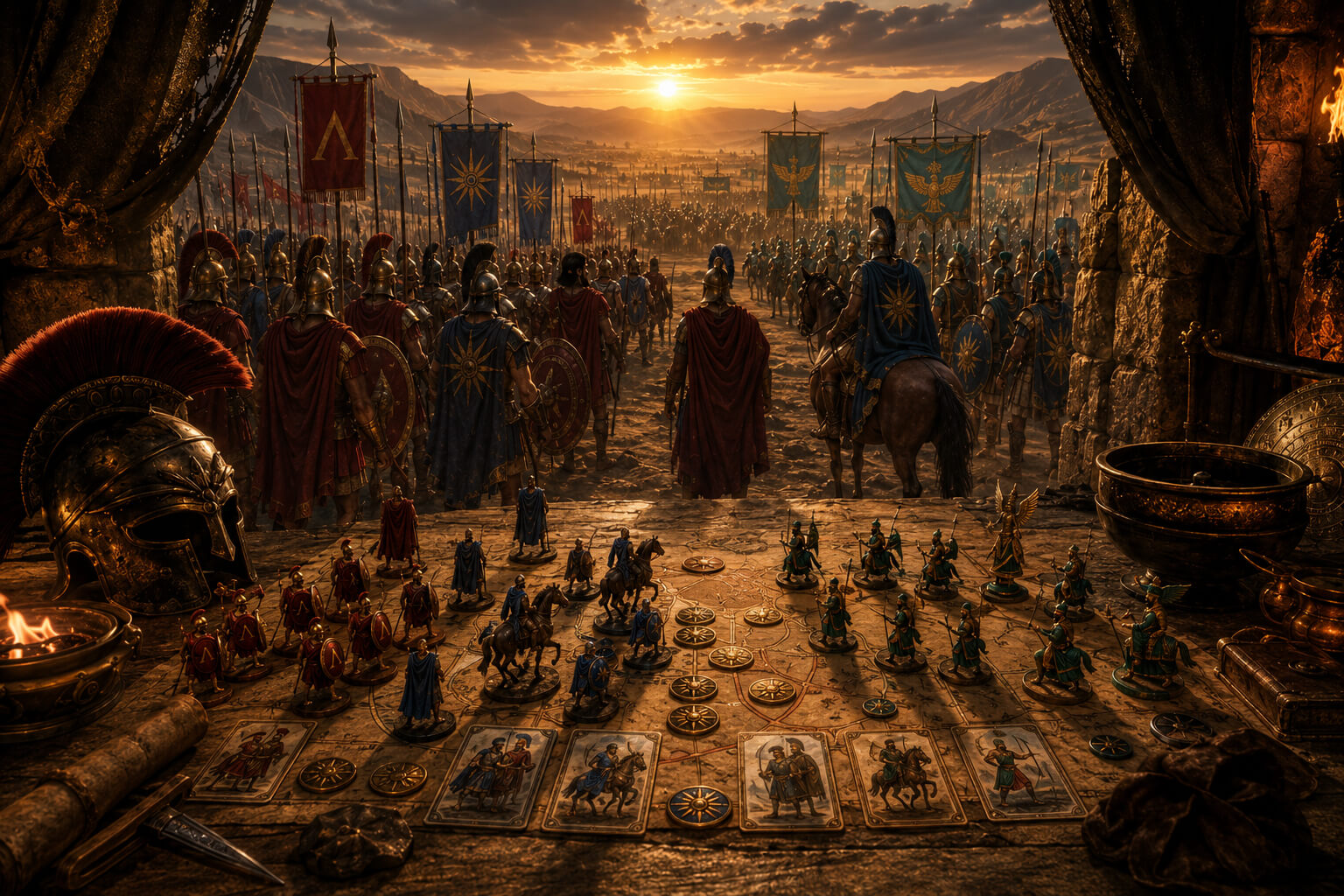
The first strategic decision in a duel is made before either player sits down. It happens in the deck builder, quietly, with no opponent in the room and nothing at stake yet, and it constrains everything that follows.
By the time the first card is drawn, you have already decided what your army is capable of. What you have not decided, and cannot, is which parts of it you will actually hold when you need them, or what the person across the table intends to do about any of it.
Forty cards is a budget, not a shopping list
A deck in Ancient Duel is exactly forty cards. You may run up to three copies of anything, one or two Commanders from your primary faction, and at most two Terrain cards. Those numbers sound like housekeeping until you try to build something, and then they behave like a budget.
Every card you include is a card you are not including. A third copy of something raises the odds you see it early and costs you a slot you might have given to an answer. An extra Tactic is one fewer Unit, and a deck that runs short on units loses to boards it should have been able to contest. A Terrain card can hold an entire strategy together and sit uselessly in your hand in the duels where it never becomes relevant.
The interesting cards make this sharper, because their value is conditional. Legionary Cohort gains defensive strength only when Testudo is face-up, so the Cohort is partly a bet that you will draw the Doctrine. Hammer and Anvil does nothing unless you control infantry and cavalry at the same time, which means including it commits you to a deck that reliably fields both. Companion Cavalry hits harder only alongside infantry. None of these is a strong card in isolation, and each of them asks you to spend more than one slot to make it good.
There is no set of forty best cards. There is a set of forty cards that work together, and building one means accepting that some perfectly good cards do not belong in it.
Consistency against flexibility
The deck shapes make this trade explicit. A Pure deck is a single faction, all forty cards. An Allied deck is thirty cards from your primary faction plus ten from one ally. A Coalition deck, available once you have unlocked three or more factions, splits twenty-six, eight and six across three.
Pure is the most consistent thing you can build. Faction effects apply to cards from their own faction unless stated otherwise, so a single-faction deck has every internal condition pointing the same way, and it draws what it expects to draw. The cost is that whatever your faction cannot do, you cannot do either. Sparta is not going to develop a cavalry plan because you would like one.
Allied buys you a tool your primary faction lacks, and pays ten cards of consistency for it. Those ten cards are not a free extension of your deck; they are ten slots that no longer contribute to your main plan, and a fair number of their effects will not reach across the faction line. Coalition goes further and gives you the widest range of answers, at the price of a real risk: a Coalition deck can end up as a collection of individually strong cards that never assemble into anything. Twenty-six cards is not many for a primary plan, and eight and six are barely enough to make a secondary one function.
The honest version is that a very consistent deck becomes predictable, and a very flexible deck often fails to draw its pieces together. Neither is the correct answer. Choosing between them is the first real strategic decision the game asks of you, and it is one you make with no information about who you will be facing.
The Commander is the first decision, not the last
Commanders are easy to treat as a finishing touch, the last card slotted into a finished list. In practice they work better as the thing you build around.
You may run one or two, they must come from your primary faction, and each leader exists as two distinct cards representing different facets of the same person. Running both versions of a leader is allowed. Running the same card twice is not. That structure means the choice is rarely about raw power and usually about direction.
A Commander who strengthens infantry in Defense pulls your deck toward holding ground, which raises the value of defensive Tactics and makes a Terrain card that rewards patience worth its slot. A Commander who improves cavalry pushes you toward units that punish openings, and toward the Doctrines that need both infantry and cavalry present. A Commander who protects a Terrain Doctrine from removal changes how confidently you can invest in terrain at all, because it removes the main reason not to.
Pick the Commander last and you get thirty-nine cards with a leader attached. Pick the Commander first and you get a deck that agrees with itself.
Then you draw five cards
This is where the plan meets its first complication, and it does so before anyone has done anything to you.
You spent your time assembling a forty-card system. The duel opens by handing you five cards from it. Your deck is what you might be able to do. Your hand is what you can do now, and the two are frequently not the same thing.
You can open with setup and no payoff: the Doctrine that makes your units work, with none of the units. You can open with payoff and no setup, holding the conditional cards whose conditions are nowhere in sight. You can draw three Tactics, which are answers to things that have not happened yet. You can draw expensive units on a turn when the energy to deploy them is several turns away. Occasionally you draw precisely the shape you built for, and those duels teach you the least.
Playing well means playing the incomplete version of your plan that this particular duel gave you. That is not a compromise imposed by the format. It is most of the skill.
Energy turns options into priorities
Energy is a single shared pool. It starts at a maximum of six, grows by one per turn from the third turn onward up to a ceiling of twelve, and refreshes at the start of your turn rather than accumulating. Whatever you do not spend is gone.
Everything draws on the same pool. Attacking costs each unit its printed Energy. Deploying a Level 5 or 6 unit costs its Energy as well. Activating a Doctrine or a Tactic costs one. You will regularly have five reasonable things to do and enough energy for two.
So the question is never what is available. It is what earns the spend this turn. Do you attack now, or spend the turn developing a board that makes next turn's attacks better? Do you commit the Commander, or hold the energy for the answer you may need on your opponent's turn? Do you establish your Terrain while the board is quiet, or keep it back for the turn the pressure actually arrives? Do you take a second attack, or leave yourself the option of activating something?
Because unspent energy does not carry over, hoarding is not a strategy either. The pool does not reward patience, only correct timing, and those are different things.
The board runs out of room
There are four positions for ordinary units and one central position reserved for the Commander. That is a small space, and it fills faster than new players expect.
Deploying is not only spending a card. It is spending a slot. A perfectly reasonable unit played on turn two can be occupying the position you want on turn four, and units do not politely step aside. It is common to reach a point where the problem is not that you lack the right card. It is that you have nowhere to put it, because your earlier decisions are still standing there.
This gives board development a shape that is easy to miss at first. Filling the board quickly applies pressure and forecloses your own options. Holding back keeps you flexible and lets your opponent build unopposed. You also get one normal deployment per turn, so the board fills at a fixed rate and cannot be corrected quickly once it is wrong.
Having an attack is not the same as having a good attack
The most common mistake I have watched is attacking because an attack is legal.
An attack is a commitment of energy, and it exposes the attacking unit to whatever the defender has arranged. Before declaring one it is worth knowing what the exchange actually produces: whether the numbers favour you, whether the face-down card next to the target is a set Tactic waiting for exactly this, whether winning the exchange leaves your unit somewhere useful or somewhere isolated, and whether the damage you gain is worth the position you give up.
Declining an obvious attack is frequently the stronger line. Holding a unit in Defense, keeping energy available, and letting your opponent be the one who commits first can be worth more than the points on the board. Tempo and aggression get confused constantly, and they are not the same thing. Tempo is about who is being forced to react.
Information accumulates
You cannot see your opponent's hand, only how many cards are in it. You cannot see their face-down units or their set Tactics. What you can see is the board, and both graveyards, in full.
The graveyards are the part players underuse. A deck holds at most three copies of any card, so once you have seen two of something, the third is the only one left, and once you have seen three, that threat is gone for the rest of the duel. If a faction's signature Tactic has not appeared by turn eight, you are making a decision about whether to play around it or accept the risk. If their Terrain went to the graveyard early, the ground is available in a way it was not before.
None of this needs to be turned into arithmetic. It is closer to bookkeeping. The player who remembers what has already been spent knows more than the player reading only the current board, and that gap widens the longer a duel runs.
Reading what the other player declines to do
After a few turns you start playing the person as well as the cards, and the useful signal is usually an absence.
An opponent who ends a turn with energy unspent has either nothing to do or something waiting. A player who passes on an attack that looked good either saw something you did not, or wants you to think they did. A face-down card followed by an unusually inviting opening is a question being asked. A Commander held back several turns past the point where it could be deployed is being saved for a turn where it will do more.
This is not psychology and it is not bluffing in the poker sense. It is simply that when both players understand the rules, the choices someone does not make are informative. You will misread these signals often. Reading them at all is still better than treating the opponent as a source of random events.
When the plan becomes the problem
The deck builder produces a plan built under ideal conditions. The opponent exists to make sure those conditions never occur.
There is a difference between following your strategy and being trapped by it. The trap looks like this: you built around a combination, the pieces are not arriving, and you keep holding cards for a setup that is not going to happen while your opponent develops freely. Every turn spent waiting makes the wait more expensive.
Knowing when to abandon the plan is a skill in itself. Sometimes a card built as a combo piece is simply a body that needs to hold a position this turn. Sometimes the deck built for a long game has to attack early because the long game has already been lost. Sometimes you concede the terrain rather than spend three turns contesting ground that has stopped mattering. A plan is useful right up until protecting the plan becomes more important than winning the duel.
The duel continues in the deck builder
A loss produces information that is worth more than the loss cost you, but only if the question afterwards is the right one.
"What did I misplay" is the obvious question and often the least useful. The better ones point back at the build. Did I run too few units and lose boards I should have contested? Did I fill slots with situational cards that were dead in most duels? Did I run one copy of a card the whole deck depends on? Did those ten allied cards cost me more consistency than the tool they bought was worth? Was there a plan I simply had no answer to, and is that a gap I am willing to leave open? Does my Commander actually support this deck, or did I include it because it is the strongest card in the faction?
The deck builder and the battlefield are not separate systems. The battlefield is where the deck is tested, and the test result is the material you take back to the builder. Build, play, observe, diagnose, adjust, play again. Most improvement happens in that loop rather than inside any single duel.
There is no perfect deck
I would not claim Ancient Duel is perfectly balanced. No card game with this many interactions is, and anyone who tells you otherwise has not played theirs enough.
What I will say is that a deck which executes its plan very well can still have real weaknesses, and that this is the intended state rather than a flaw to be patched out. If forty cards could answer every situation, deck building would have no cost, and a decision with no cost is not a decision.
The weaknesses are part of the deck's identity. A Spartan defensive build accepts that it will struggle against something that refuses to engage. An aggressive Dacian build accepts that it loses long games. Choosing which problems you are willing not to solve is as much a part of strategy as choosing which ones you will.
Simple rules, compounding decisions
Nothing described here is individually complicated. Forty cards. Three copies. Five in hand. A pool that refreshes. Four slots and a fifth for the Commander. Attack or Defense. Numbers from one to six.
The difficulty comes from the way these constraints multiply. Your deck determines what you can draw. Your draw determines what your energy is worth this turn. Your energy determines what you can put on a board that has limited room. The board determines which attacks exist. The attacks determine what ends up in the graveyards, which changes what both players know. And every one of those states is being pushed on by someone who wants a different outcome.
No single choice in that chain requires deep analysis. The chain does, because each link narrows the next.
From deck building to battlefield
In the deck builder you decide what your army is supposed to do. On the battlefield you find out what it can still do while somebody is actively trying to stop it.
The deck is a plan made in ideal conditions, with full information, unlimited time, and no opponent. The duel subjects it to incomplete information, limited energy, limited space, a draw you do not control, and another person's intentions. Strategy is not really located in either place. It lives in the distance between them, and in how well you handle the fact that the distance is never zero.
Daniel Rusu
Creator & Developer of Ancient Duel