Seven Armies, Different Ways to Win: How Faction Identity Works in Ancient Duel
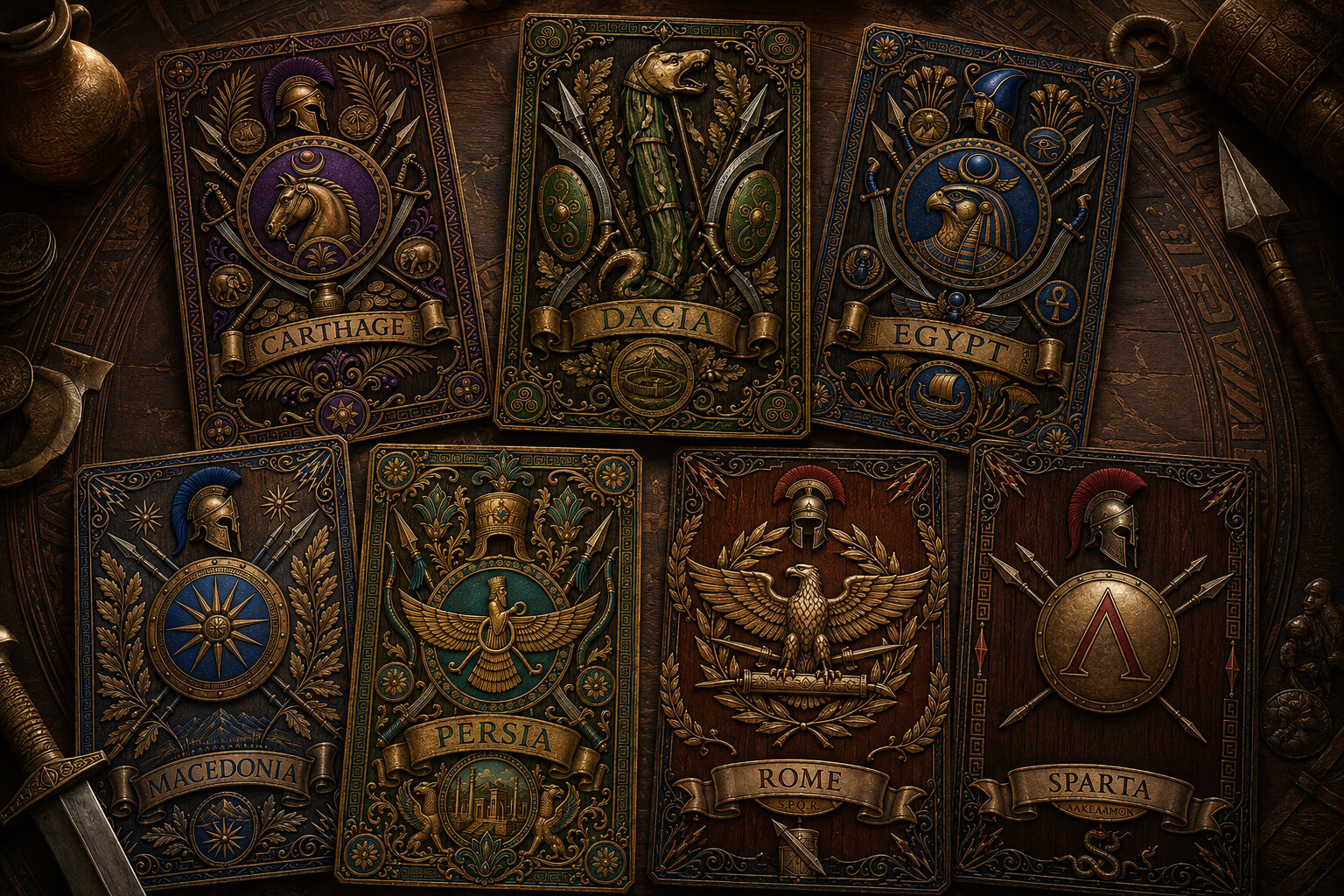
Two players sit down. Same board, four unit positions and a fifth reserved for a Commander. Same forty-card deck size. Same shared energy pool that refreshes rather than accumulates. Same combat comparison, same numbers between one and twelve, same six phases in a turn. Nothing about the framework knows or cares which army you brought.
So where is the difference supposed to come from?
The lazy answer is to give each faction its own rules. Rome gets a special phase, Persia gets an extra draw step, Sparta ignores some restriction everyone else obeys. That produces armies that feel different and a game that becomes unteachable, because learning the second faction means learning a second rulebook, and playing against the seventh means knowing all of them. I did not want a game where the barrier to a new opponent is the reading.
The alternative is harder to design and much better to play: keep the rules identical and change what the cards make you want to do.
The shared skeleton
It is worth being specific about how much the seven armies actually have in common, because the answer is nearly everything.
Every faction has twenty or twenty-one cards in the pool, roughly split into units, Doctrines and Tactics. Every faction has exactly five Tactics. Every faction has one Terrain Doctrine and one equip-style Doctrine that attaches to a unit. Every faction has at least one card that digs through the deck for something. Every faction has two Commander cards representing one leader in two facets, and the same rule that only one Commander may be face-up on your side at a time.
The structural template is the same seven times over. What changes is what goes in each slot, and that turns out to be enough.
Rules say what you can do; cards say what you want to do
The clearest illustration in the game is a card that exists twice.
Rome has Shield Wall Response: when an Infantry you control is attacked, negate the attack. Sparta has Hold the Line: when an Infantry you control is attacked, negate the attack. Same trigger, same effect, same cost. Two different factions, and if you judged either army by that card alone you would conclude they play identically.
They do not, because of what sits around it.
Rome's other Tactics are about the line continuing to exist. Reserve Rotation fires when an Infantry you control is destroyed in battle and puts a fresh one from your hand onto the board in Defense. Ordered Relief pulls a targeted Infantry back into Defense and gives it two defense for the turn. Disciplined Advance pushes an Infantry the other way, out of Defense into Attack with a point of attack for the turn. Rome's units reinforce that: Legionary Cohort gains defense only while Testudo is face-up, Principes Line gains attack only while you control Hastati Line. The faction keeps asking the same question, which is not "can I win this fight" but "will my line still be standing in two turns".
Sparta's other Tactics are about the exchange itself going badly for the attacker. No Step Back means an Infantry that would be destroyed in battle simply is not. Counter-Thrust destroys an attacker that failed to kill your Infantry. Iron Resolve negates an effect that targets one of your units. Leonidas, King of Sparta makes your units in Defense immune to enemy Tactics outright. Narrow Pass, Sparta's Terrain, limits the opponent to one declared attack per turn.
The same negate-an-attack card is a repair tool in one deck and a trap in the other. Neither faction needed a special rule to get there.
Identity is an ecosystem, not a label
I deliberately avoided designing to adjectives. Deciding that one faction is "the aggressive one" tends to produce a pile of cards with high attack and nothing to say, and the player learns the label instead of the army.
What works better is when several unrelated cards independently push toward the same behaviour. Macedonia is the cleanest case. Its unit pool is the only one with a near-even split between infantry and cavalry, four of each. Then: Pezhetairoi Phalanx gains attack for each other infantry or cavalry you control. Companion Cavalry hits harder only while you control an infantry unit. Coordinated Charge pays out when your cavalry attacks while you control an infantry. Hammer and Anvil destroys an enemy unit only if you control an infantry and a cavalry at the same time. Alexander, Lord of Combined Arms draws you a card each turn on the same condition.
Five different cards, three different card types, one repeated demand: bring both arms. No single card explains Macedonia. The pattern does. The name of the Doctrine is drawn from the term historians use for the Macedonian system under Philip II and Alexander, where a pike line pinned an enemy and the cavalry delivered the decisive blow, but the card is not a simulation of that. It is a condition that makes you build a deck containing both, and then makes you keep both alive.
Identical numbers, different cards
Because the whole game runs on a compact scale, faction identity cannot come from stat inflation. There is no room for it. What it comes from instead is what a number is attached to.
Sparta's Skiritai Scouts and Macedonia's Thessalian Cavalry are both Level 2, both cost two energy, and both gain a point of attack when attacking a unit in Defense. The text is nearly the same. But one is Infantry in a faction whose Doctrines and Commanders repeatedly say "your Infantry", and the other is Cavalry in a faction whose payoffs demand cavalry standing next to infantry. The identical ability lands in two different webs of conditions.
Persia's Median Cavalry has the same 3/1 body as the Thessalian and a blunter effect: it gains two attack whenever it attacks, no condition attached. It hits harder and dies to anything. Rome's Triarii Reserve and Carthage's Punic Spear Guard share an effect word for word, taking a point of attack off anyone who attacks them in Defense, on bodies of 4/4 and 3/4 respectively.
None of these differences would be visible on a spreadsheet of statistics. All of them matter at the table.
Commanders as a lens
Each leader exists as two Commander cards, and only one can be face-up at a time, so choosing between them is a real decision rather than a collection. What interests me more is how much the Commander tells you about the faction underneath it.
Line them up and the auras form a spectrum of specialisation. Darius, Great King gives one defense to your units, with no restriction at all. Alexander, King of Macedon gives attack to your Cavalry. Ramesses, Lord of the Two Lands gives attack to your Chariot units. Trajan, Imperial Vanguard gives two attack to your Infantry. Decebalus buffs Infantry as well, but his once-per-turn ability only functions while a Terrain Doctrine is face-up on the field.
That last one is the interesting shape. Decebalus does not simply reward Dacia's units; he makes an entire other card category a precondition for his own ability. The same requirement appears on Hill Spearmen, which gain defense only while a Terrain Doctrine is face-up, and on Hidden Ravine, which negates an attack only while Forest Paths specifically is face-up. Dacia is the faction where establishing and holding the ground is not flavour text but a switch that turns other cards on.
A Commander who changes what the rest of your board is worth does more work than a Commander with a bigger attack value, and it costs the same slot.
Doctrines and Tactics carry as much identity as units
If identity lived only in units, every faction would be a list of soldiers. It is often the non-unit cards that say the most.
Carthage is the example I would point to. Its recurring motif is turning losses into resources. Iberian Mercenaries draw you a card when they are destroyed in battle. Punic Logistics gives a life point and a card cycle once per turn when a unit you control is destroyed. Ruthless Bargain draws two when a Mercenary or Cavalry of yours dies. Alongside that sit three separate cards that fetch things: Mercenary Contracts, Silver for the Spear, Harbor Supply. Numidian Cavalry drops back into Defense automatically after attacking, and Hannibal Barca, Master of Envelopment lets a unit do the same by choice.
The picture that emerges is an army that is comfortable spending troops and uncomfortable standing still. Carthage historically fought with mercenaries and subject contingents rather than a citizen levy, and the design takes an idea from that, but what the cards actually implement is an economy: bodies convert into cards, and cards convert into more bodies.
Persia goes at the same problem from the other end. Rather than profiting from losses, it tries to stop the attack happening. Arrow Curtain takes three attack off a declared attacker. Rain of Arrows removes two from every face-up enemy unit for the turn. Ordered Withdrawal pulls the target into Defense and negates the attack entirely. Oasis Encampment weakens enemies as they come in. Then, for what does die, the graveyard is a second hand: Royal Road returns a low-level unit from it once per turn, Darius in his other facet does the same, and Immortal Guard replaces itself from the deck when destroyed.
Strengths need weaknesses to mean anything
A faction that does everything well has no identity, only an advantage. The interesting part of the design is what each army is bad at.
Sparta has nine infantry units out of nine non-Commander units, and no cavalry whatsoever. That is not an oversight. It means a Spartan deck cannot build a cavalry plan, cannot use effects that ask for combined arms, and has to solve mobility problems some other way or not at all. Persia is the reverse: the widest spread of unit types in the game, chariots, cavalry, missile infantry, a guard, a satrap, a level-one messenger, and only two units that are plain infantry, which makes several infantry-conditional payoffs unavailable to it.
Egypt's conditionals point at its own Doctrines rather than at unit types. Temple Guard gains defense only while you control a face-up Doctrine; Nile Spearmen only while a Terrain Doctrine is face-up. Ramesses, Guardian of the Nile gains a life point for each of your units in Defense, up to three, and Granary Stores does a smaller version of the same. That is an army rewarded for holding a defensive board and punished for being forced to race, and if the opponent never lets it settle, several cards in the deck are simply worse.
Those weaknesses are the reason adaptation exists. Sooner or later every deck has to solve a problem it was not built for.
Why mixing factions costs something
There is one rule that quietly does most of the work here: unless a card says otherwise, a card's effects apply only to cards from its own faction. Testudo strengthens Rome infantry. Narrow Pass protects Sparta units. Hammer and Anvil checks for a Macedonian infantry and a Macedonian cavalry, not any two units.
That single restriction is what makes deck structure a strategic choice rather than a formality. A Pure deck is forty cards from one faction, every condition pointing the same way. An Allied deck is thirty from your primary faction plus ten from a single ally. A Coalition deck, available once you have unlocked three or more factions, splits twenty-six, eight and six across three. Commanders must always come from the primary faction, and if you run Terrain at all, at least one must be primary too.
So the trade is legible. Those ten allied cards buy you something your faction cannot do, and they pay for it twice: ten slots no longer serving the main plan, and a set of effects that mostly will not reach across the faction line. Coalition widens the toolbox further and narrows the core to twenty-six, which is not many cards to build a coherent plan out of.
I would not tell you Pure is stronger. It is more consistent, which is not the same thing. The honest framing is a question the deck builder asks and does not answer: how much identity are you willing to trade for flexibility?
A different opponent is a different question
Asymmetry changes what you are trying to work out, and it changes it before you know anything for certain.
Against a faction whose Tactics punish attackers, the question is whether an obvious attack is a trap. Against one that converts dead units into cards, trading efficiently might be doing your opponent a favour. Against an army that needs terrain face-up for several cards to function, contesting the terrain zone stops being an incidental play and becomes an attack on their engine, since only one Terrain Doctrine can be face-up at a time and activating yours destroys theirs.
You do not get told which of these you are facing. You get a faction, a board, and a graveyard filling up with evidence. Learning a second army is largely learning to recognise, from four or five cards, what a third player is trying to assemble.
Seven armies, one rulebook
The thing I was actually trying to build was not seven armies. It was seven different sets of habits inside one set of rules.
A Roman player thinks about whether the line survives. A Spartan player thinks about making the attack into them the wrong choice. A Macedonian player thinks about keeping two arms on the board at once. A Carthaginian player thinks about what a dead unit is worth. A Persian player thinks about the attack that has not happened yet. A Dacian player thinks about the ground. An Egyptian player thinks about whether they are allowed to settle.
None of that required a separate rulebook, an extra phase, or a stat nobody else has. It came from what each faction's cards keep asking for, and from what each faction cannot do at all.
The rules tell both players what is possible. The faction decides which of those possibilities is worth wanting.
Daniel Rusu
Creator & Developer of Ancient Duel