What Ancient Duel Takes From History — and What It Invents
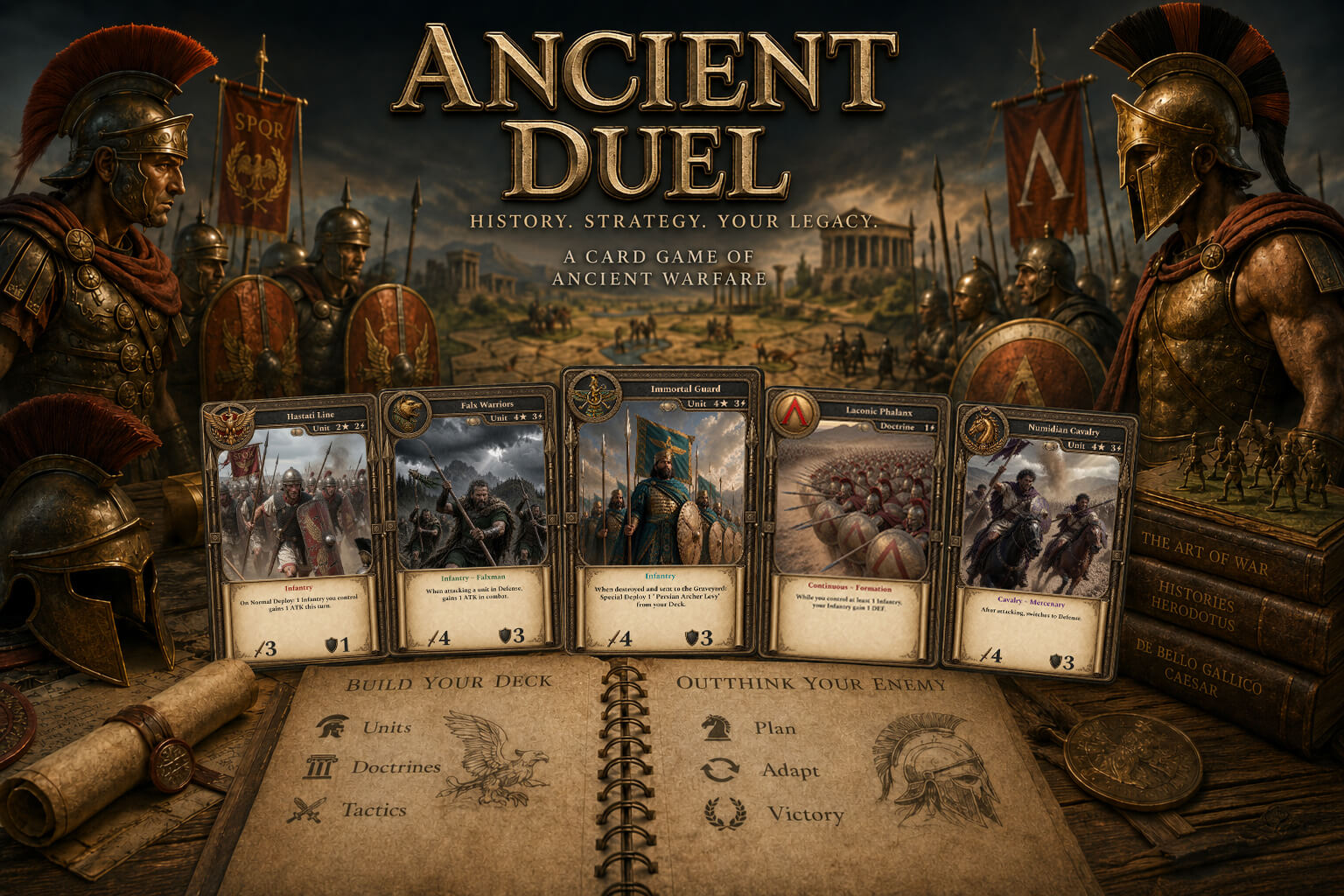
A while ago someone asked me whether Ancient Duel is an educational game. I said no, and then spent the rest of the evening annoyed at my own answer, because it isn't quite true either.
Ancient Duel doesn't teach history. It's a card game. But it is built on real ancient warfare, and I've watched enough people stop mid-match to ask "wait, what's a falx?" to know that something happens when history is the material a game is made of rather than a coat of paint on top of it. This article is my attempt to be precise about what that something is — and about where the history stops and my design decisions start.
What's actually in the game
7 civilizations: Rome, Sparta, Macedonia, Carthage, Persia, Dacia and Egypt. 141 cards across them — 65 Units, 42 Doctrines, 34 Tactics. 19 real battles rebuilt as campaign missions, most of them playable from both sides. 35 missions in total, each opening with a short historical briefing before the first card is drawn.
That's the raw material. Here's how honest I can be about each part of it.
What's historically grounded
The civilizations are real, obviously. So are the commanders: Leonidas, Alexander the Great, Darius, Hannibal Barca, Trajan, Decebalus, Ramesses. Every one of them led armies, and the campaign each anchors follows events that happened.
The unit types are where I spent the most research time, and they're the part I'd defend hardest. Rome's Hastati Line, Principes Line and Triarii Reserve are the three lines of the manipular legion. Sparta fields Perioikoi Spearmen and Skiritai Scouts — the free non-citizens of Laconia and the light troops from the Skiritis district. Macedonia has Pezhetairoi, Hypaspists and Companion Cavalry. Carthage recruits Balearic Slingers and Numidian Cavalry because Carthage recruited Balearic slingers and Numidian cavalry. Persia has its Cardaces and Scythed Chariots; Egypt its Medjay Guard; Dacia its Tarabostes Nobles and Comati Raiders, the two social classes Roman sources describe.
The doctrines are real formations and real operational methods. Testudo. The Laconic Phalanx. Sarissa Drill, for the pike that gave Macedonian infantry its reach. Hammer and Anvil, which is the name historians give to the combined-arms system of Philip and Alexander the Great. Double Envelopment, which is what Hannibal did at Cannae.
And the battles are dated and located: Thermopylae (480 BC), Plataea, Granicus, Issus, Gaugamela, Megalopolis, Trebia, Lake Trasimene, Cannae, Zama, Sellasia, Pelusium, Papremis, the Nile against Perdiccas, Alexandria (30 BC), and the Dacian Wars from First Tapae in 88 AD to the fall of Sarmizegetusa in 106 AD.
What's historically inspired, but adapted
This is the largest category, and it's where design starts making decisions history didn't.
Take Sparta's Agoge Training. The agoge was a real state upbringing that produced the only full-time professional infantry in classical Greece. In the game it reads: "Your Level < 5 Infantry gain 1 ATK." That's not history — that's a designer deciding that decades of institutional training should show up as a small, reliable bonus on your cheaper troops rather than your elites. The idea is historical. The number is mine.
Persia's Immortal Guard is my favourite of these. Herodotus describes the corps as being kept permanently at ten thousand men, each casualty replaced at once. So the card reads: "When destroyed and sent to the Graveyard: Special Deploy 1 Persian Archer Levy from your Deck." The unit refills itself. Whether Herodotus was describing an administrative fact or repeating a story he'd been told is genuinely debated — but the card is honest about which reputation it's modelling.
Numidian Cavalry switches to Defense after it attacks, because Numidian horsemen fought as skirmishers who struck and withdrew rather than committing to a shock charge. Falx Warriors gain ATK when attacking a defending unit, because the Dacian falx was a hooking blade meant to reach past a shield — and Rome's answer was reinforced helmets and arm guards. Narrow Pass limits your opponent to one attack per turn, which is a rule-shaped way of saying "Thermopylae."
None of these are simulations. They're arguments about what mattered, compressed into one line of card text.
What's pure gameplay fiction
And then there's the part I'd rather state plainly than have someone discover and feel misled by.
Every number is invented. ATK, DEF, Energy and Level all run from 1 to 6. Spartan Hoplites are 4/3 and Falx Warriors are 4/3 not because those forces were equivalent but because a game where every stat is small and readable is a game a new player can hold in their head. The stats exist to be balanced, not to be true.
The timeline is broken on purpose. Ramesses commanded in the 13th century BC. Trajan died in 117 AD. They can meet across a table, and one of them will lose. Leonidas can fight Decebalus, six centuries apart. An Allied deck lets you field 30 Spartan cards alongside 10 Egyptian ones; a Coalition deck mixes three factions at once. No such army existed.
Each commander exists as 2 cards. Leonidas is both "King of Sparta" and "Voice of Defiance"; Hannibal is "Master of Maneuver" and "Master of Envelopment". That's a deck-building construct — two facets of one leader so you have a real choice about which version of him you build around — not a claim about two historical people.
Some rules are pure mechanism. The Kamikaze rule, where a losing attacker still leaves a lasting wound on the unit that killed it, exists because I wanted weak units to have a purpose beyond dying. The rule that only one Terrain Doctrine can be face-up at a time — so activating yours destroys your opponent's — compresses "both armies want the same ground" into something you resolve in three seconds.
I'd rather you know all of this. A player who can tell which parts of a game are load-bearing history and which parts are scaffolding can go and read about the first category without being quietly misinformed by the second.
History as a starting point, not a syllabus
Nobody memorises dates from a card game, and I've never tried to make that happen. What a game can do is put a name in front of you often enough that you eventually get curious.
You draw Sarmatian Allies for the fourth time and wonder who the Sarmatians were. You read "Medjay Guard" and wonder why Egypt's guards have a Nubian name. You lose to Double Envelopment and want to know whether that actually worked. You notice that Trajan's second card is called "Builder of Provinces" and that his campaign ends at a place called Sarmizegetusa.
Those questions get answered somewhere else — a book, an article, a documentary. The game's job is only to make the question occur to you.
Strategy starts before the first card is drawn
The second half of this is the part I care about as a designer rather than as someone who likes history: a duel is decided partly by choices you made before it began.
A deck is exactly 40 cards, up to 3 copies of anything, 1 or 2 Commanders from your primary faction, and at most 2 Terrain cards. Play pure, or Allied at 30 primary plus 10 from one ally, or Coalition at 26 / 8 / 6 across three factions.
Those constraints do the teaching. 40 slots is not many. Every Doctrine you add is a Unit you don't. 3 copies of a card you want to see early raises the odds of drawing it and raises the odds of drawing a second, useless copy late. Splashing an ally faction gets you a tool your primary lacks and costs you 10 cards' worth of consistency — and most effects only apply to cards from their own faction, so a mixed deck buys flexibility with synergy.
Then there's the interlock. Legionary Cohort gains DEF only if Testudo is face-up. Hammer and Anvil does nothing unless you control both Infantry and Cavalry. Companion Cavalry hits harder only while an Infantry unit stands beside it. Those cards aren't strong; they're strong together, which means a deck is a system and not a ranking. The most common mistake I see is 40 individually good cards that never help each other once.
And then the plan meets the turn
You start at 20 life, draw 5, and every turn refills a single shared energy pool — 6 at first, rising by 1 from turn 3 up to a cap of 12. That pool pays for attacking (each unit costs its printed Energy), for deploying Level 5–6 units, and for activating Doctrines and Tactics. Unspent energy is lost at the next refill.
One shared pool for everything is the most important decision in the game, because it makes every turn a budget. Attack with the big unit, or deploy the commander? Activate the terrain, or keep energy for a second attack? You get one normal deploy per turn, so the unit you commit is the unit you're stuck with.
Then position. A unit in Attack Position can strike but is compared on ATK when struck. Set face-down in Defense, it's hidden, safe from ATK-vs-ATK trades, and compared on DEF instead — and your opponent can't see what it is until they attack into it. Beating an attacking unit deals the difference to your opponent's life; losing your own attack costs you the difference and your unit. So "should I attack" is rarely obvious, and "should I hold" is a real answer.
Your opponent has a plan too
This is the part that makes a duel a duel rather than a puzzle.
You cannot see your opponent's hand — only how many cards are in it. You cannot see their face-down units or their set Tactics. What you can see is both graveyards, in full, which is the honest information channel in the game: what they've already spent tells you what they might still have.
And Tactics resolve on your turn, not theirs. When you declare an attack, your opponent gets a window to respond with something they set 2 turns ago. Feigned Retreat cancels the attack outright and puts a fresh unit on their board. Pilum Volley strips 2 ATK and 2 DEF off your attacker mid-swing. Punic Ambush punishes you specifically for attacking a face-down unit. You commit energy to an attack and find out afterwards whether it was the right one.
So the plan you built survives about 3 turns. After that you're reading: two face-down cards and a passed turn probably means they're holding a response; a commander deployed early means the follow-up is coming. You build a strategy before the duel, and you rebuild it while the duel is happening. That gap — between the plan and the board — is where the interesting part of this game lives.
Losing is where the learning is
I don't think of the competitive side as aggression. A ranked ladder and a leaderboard exist for one reason: they make a loss worth examining.
A duel you lose leaves a specific question behind. Did I run out of energy at the wrong moment? Did I attack into a set card I should have suspected? Was my deck missing an answer to a strategy I'd already met three times? Every one of those has a fix, and the fix is either a different decision or a different deck.
That loop — lose, diagnose, adjust — isn't unique to Ancient Duel. The game just makes the feedback fast and the record legible.
Easy to learn, deep enough to master
I want to be careful here, because this is where game descriptions usually start making promises they can't keep. I'm not going to claim an age range or a cognitive benefit. What I'll claim is a design distinction I think about constantly: rule complexity and decision complexity are not the same thing.
Ancient Duel's rules are deliberately small. Every number is 1 to 6. Combat is one comparison: bigger wins. 6 turn phases, 5 unit slots, 1 energy pool. You can be playing correctly within a few minutes, which is why the same rules work at a table with printed cards as they do online.
The decisions on top of those rules are not small. Which 40 cards. Which 2 commanders, and which facets. Whether to hold a Tactic for a better window or use it now. Whether the face-down card across the table is a threat or a bluff. How to spend a budget that's always slightly too tight. Whether to change a plan that was correct two turns ago and isn't any more.
A game doesn't need complicated rules to produce complicated positions. It needs rules that interact. That's why I don't describe Ancient Duel as a children's game — a ten-year-old can play it, and so can someone who's been building decks for twenty years, and they're not playing a different game.
What I'm actually claiming
Not that Ancient Duel teaches history. It doesn't, and any game that says it does is overselling.
What it does: use real ancient warfare as its foundation, mark clearly where that foundation ends and my design begins, and put you in a position where you have to plan, anticipate, adapt and live with your choices.
If somewhere in there you get curious about who the Skiritai were, or why the double envelopment at Cannae is still taught, that's the best outcome I could ask for — and it happens because the history was real enough to be worth asking about.
Ancient Duel was never meant to replace history books — it was meant to make players curious enough to open one.
If a battle, commander, faction or card makes someone wonder, "Did this really happen?", then the game has already achieved something beyond winning or losing a duel.
History provides the foundation. Strategy gives the player freedom.
And somewhere between the two, every Ancient Duel becomes a story of its own.
Daniel Rusu
Creator & Developer of Ancient Duel