How Ancient Warfare Becomes Gameplay in Ancient Duel
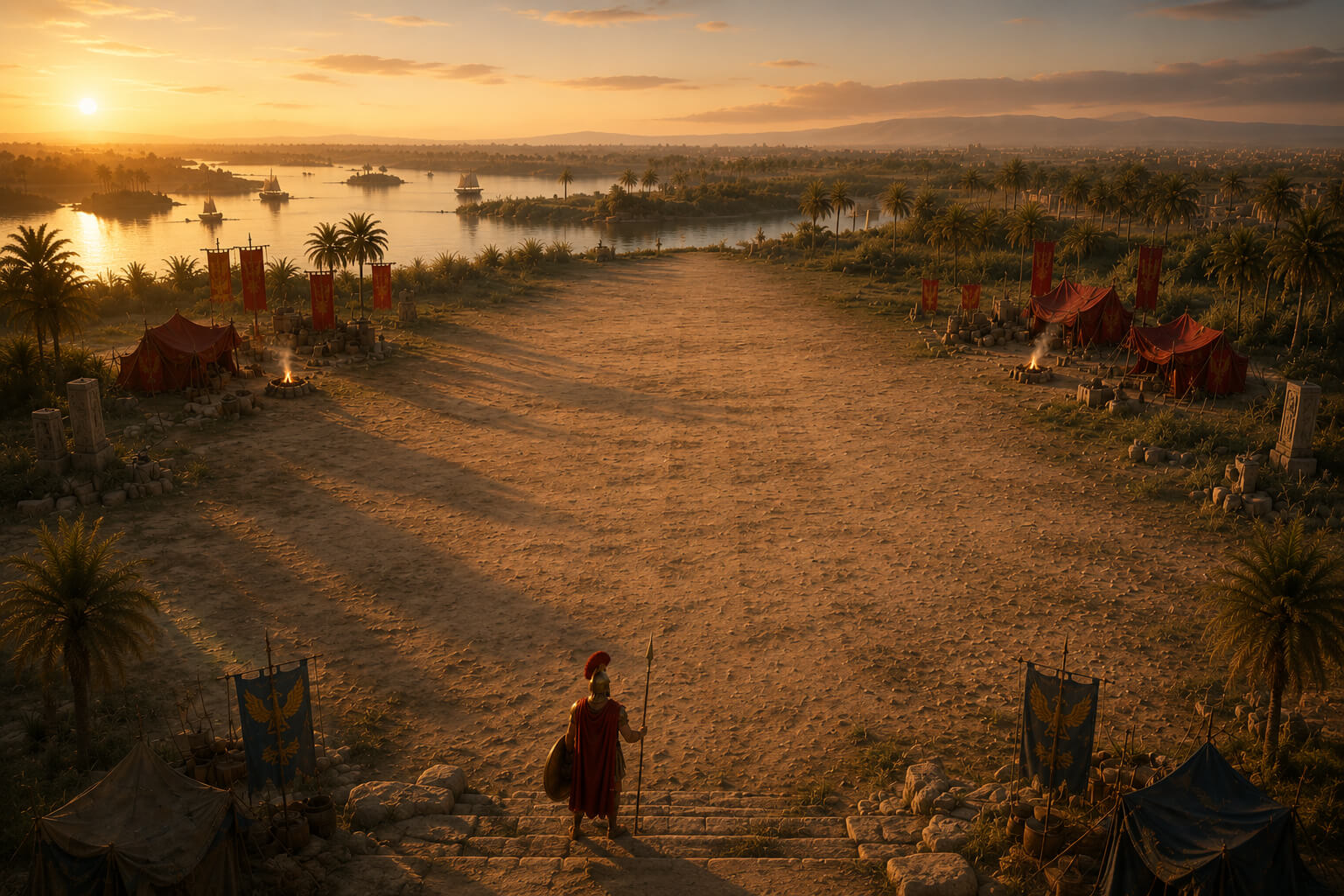
A good unit in the wrong place is worth very little. That sentence is close to the whole of ancient warfare, and it is also the design problem I spent the longest time on.
Armies did not lose because their soldiers were individually worse. They lost because a formation was committed too early, or caught on ground that took away its advantage, or hit from a direction it could not turn to face, or left without the support it was built to fight alongside. The Theban Sacred Band, the Spartan hoplite, the Macedonian pikeman: each of them was formidable under the conditions they were designed for, and each of them could be made irrelevant by conditions someone else chose.
Which leaves a designer with an awkward question. How do you put that into a card game without building a military simulator nobody wants to play?
Armies were systems, not collections of warriors
The useful thing about ancient armies is that their parts were not interchangeable. Heavy infantry held ground and won by cohesion, which is also what made it fragile: a phalanx that kept its line was very hard to break from the front, and the same phalanx on broken or uneven ground stopped being a phalanx at all. Polybius makes exactly that point about the Macedonian formation, and it is one of the few tactical judgements from antiquity that reads like a modern analysis.
Light troops and missile infantry rarely decided a battle on their own, but they shaped it: slingers and archers harassed, disordered, and forced an enemy to react. Cavalry, in the Mediterranean world of this period, very seldom broke formed heavy infantry by charging into its front. What it did instead was exploit, going after flanks, rear, baggage, and anything already coming apart.
None of these parts is meaningful in isolation. Cavalry was dangerous because infantry pinned the enemy in place for it. Infantry could hold because someone kept the flanks honest. That interdependence is the thing I actually wanted in the game, more than any particular weapon or formation.
So in Ancient Duel a card is rarely worth reading on its own. Companion Cavalry hits harder only while you control an infantry unit. The Laconic Phalanx strengthens your infantry only while at least one infantry unit is already on the board. Hammer and Anvil, named for the system Philip and Alexander the Great built their army around, does nothing at all unless you control infantry and cavalry at the same time. The card text is doing something simple, but the habit it builds is the historical one: stop asking what this unit does, and start asking what it does next to that one.
Position can matter as much as strength
Thermopylae is the obvious case, and it is obvious for a reason. A pass narrow enough denies a larger army the ability to bring its numbers to bear, which is why the Greek position held for as long as it did and why it fell the moment a path around it was found. Gaugamela is the inverse: Darius chose flat, open ground precisely so that his numbers and his scythed chariots would have room, and lost anyway when Alexander the Great pulled the Persian line apart and drove at the gap it left. At Cannae, the Roman army was not outfought so much as out-positioned, its own weight of numbers turned into a liability once the wings closed behind it.
I did not want a movement system. Grids and facing rules produce a different kind of game, slower and more procedural than the one I was trying to make. What I wanted was for placement to carry a decision without carrying a rulebook.
So the battlefield in Ancient Duel is deliberately small. Each side has four positions for ordinary units and one central position reserved for the Commander, and that reservation is enforced: a Commander can only be deployed to the middle, and nothing else can be deployed there. The board is a formation with a leader in it rather than a map.
The decision lives in the other axis. A unit stands in Attack Position, where it can strike but is measured on its ATK when something strikes back, or in Defense Position, where it cannot attack but is measured on its DEF. A unit set face-down enters Defense hidden, and your opponent finds out what it is by attacking into it. A unit that was deployed this turn cannot change stance, so the posture you choose is one you live with for a turn. Several effects then move units between those stances, sometimes across the table: Alexander, King of Macedon can force any face-up unit on either side into the position of his choosing, once per turn.
The point is not that placement is visual. It is that where a card sits, and how it stands, is a commitment made before you know what the answer to it will be.
Terrain changes what an army is worth
Ground did not merely host ancient battles, it selected which army was allowed to be good. A river line raised the value of whoever held the crossing. Hills punished anyone attacking uphill in armour. Broken country ruined formations built for open ground. Commanders spent enormous effort trying to fight where their own strengths would count, which is a large part of what generalship consisted of.
Terrain Doctrines in Ancient Duel are not depictions of specific places. Narrow Pass is not a map of Thermopylae, and I would not defend it as one. It is an abstraction of a single idea: that the battlefield should have an opinion about what happens on it.
What makes them interesting is that there is only one battlefield. The terrain zone is shared, and only one Terrain Doctrine can be face-up at a time, so activating yours destroys whatever your opponent had established. Both players want the same ground and only one of them gets it, which is roughly the correct shape for the historical problem even though it resolves in three seconds.
Each one bends the rules toward its faction. Narrow Pass gives your units a point of DEF and limits your opponent to a single declared attack per turn, which is a rule-shaped way of saying that a confined space stops an army from using everything it has. Dacia's Forest Paths adds attacking power specifically against units in Defense, rewarding an army built to pry defenders out of position. Persia's Oasis Encampment weakens attackers as they come in, and Rome's Fortified Camp shuts off direct attacks in a turn where you have already lost a unit.
Commanders should change the battle, not just the numbers
This was the section of the design I cared about most, and the one I got wrong first.
The easy version of a famous general is a card with large numbers on it. That version is boring, and worse, it is historically backwards. Hannibal is not remembered for personal combat power. He is remembered for the Trebia, for Trasimene, for Cannae, which is to say for arranging battles so that his opponent's strengths stopped mattering. Alexander the Great is remembered for a system, and for knowing exactly when to commit himself to a gap. Leonidas is remembered for holding a position that could be held. What made these men significant was the way armies behaved around them.
So every Commander in Ancient Duel is built to change how you play rather than to win a fight by arithmetic. They are still units, and they still have to fight, but their numbers are the least interesting thing about them.
Hannibal Barca, Master of Maneuver forces an enemy unit into Defense the moment he arrives and can strip attack power from a target once per turn, which is a card about dictating the terms of an engagement rather than winning one. His other facet lets a unit slip back into Defense after attacking, so aggression stops being a one-way commitment. Leonidas, King of Sparta makes your units in Defense immune to enemy Tactics, changing what your opponent can even attempt. Trajan, Builder of Provinces protects a Terrain Doctrine from removal and pulls infantry back out of the graveyard, which is the closest I could get to Roman engineering as a playstyle rather than flavour text.
There is also a rule that matters more than any single card: only one Commander can be face-up on your side at a time, and deploying a second sends the first to the graveyard. You do not accumulate leadership. You choose it, and changing your mind costs you the man you already committed.
Timing is a weapon
A correct decision made at the wrong moment is not a correct decision. Reserves committed too early are just more men in the front line, and a charge launched before the enemy is fixed in place is a charge into an intact formation. Most of the interesting failures in ancient battle accounts are failures of timing rather than of courage or equipment.
The mechanism carrying this in Ancient Duel is a single shared energy pool. It starts at a maximum of six, grows by one per turn from the third turn onward, and refills at the start of your turn rather than accumulating. Everything competes for it: attacking costs each unit its printed Energy, deploying a Level 5 or 6 unit costs its Energy as well, and activating a Doctrine or Tactic costs one. Whatever you do not spend is gone when the pool refills.
One pool for every kind of action is the most consequential rule in the game, because it turns each turn into a budget rather than a checklist. Attacking with your heaviest unit and deploying your Commander in the same turn is frequently not possible. You also get one normal deployment per turn, so the unit you commit is the unit you have. The question the game asks, over and over, is not what you would like to do. It is what matters now and what can wait.
A unit is worth what stands beside it
Ancient formations were mutually supporting almost by definition. A shield wall works because of the man to your right, skirmishers screened the line and withdrew through it, and the whole logic of combined arms is that each element covers a weakness in another.
Ancient Duel expresses this mostly through conditions rather than through geometry. Spartan Hoplites become stronger if you control another unit at all. Shield-Bearer Youths reinforce an infantry unit as they arrive. Coordinated Charge only pays out when your cavalry attacks while you control infantry, which is the hammer and anvil compressed into one line of text. Medjay Guard, standing in Defense, prevents your opponent from targeting anything else, which is the clearest case of a unit whose value is entirely about what it protects rather than what it kills.
The practical consequence is that ATK and DEF are the beginning of evaluating a card, not the end. A 3/1 cavalry unit is fragile on its own and dangerous in the right company. Reading a board means reading the relationships on it.
Abstraction is the whole job
I want to be plain about the size of the simplification here, because pretending otherwise would be the same dishonesty the first article was written to avoid.
A real ancient battle involved thousands or tens of thousands of people, supply and water, morale that could collapse without warning, orders that arrived late or not at all, dust and weather, terrain the commander had not fully seen, troops of wildly varying experience, and a great deal of luck. No card game reproduces that, and a card game that tried would be unplayable long before it was accurate.
Design is therefore mostly deciding what to throw away. Ancient Duel keeps a short list: units depend on each other, ground matters, posture is a commitment, resources are finite, leadership changes behaviour, and you cannot see everything your opponent holds. Everything else goes. The aim is not to reproduce an ancient battlefield, but to preserve a few of the questions a commander would have recognised.
From battlefield problem to card effect
It may be more useful to show the process than describe it. Each of these began as a historical observation, became a design question, and ended as something a player has to decide.
Confined ground
A larger army cannot always use its advantage in a restricted space. The question was how a battlefield could take options away without rules about movement or distance, and the answer was a Terrain Doctrine that caps how many attacks the opponent may declare per turn. The decision it creates is when to spend energy establishing it, and whether to hold it for the turn the pressure actually arrives.
Cavalry as exploitation
Cavalry punished disorder and openings rather than winning frontal contests. The question was how to make it feel unlike infantry without a movement system, and the answer was conditional aggression: Median Cavalry hits far above its size when it attacks and is badly exposed if anything hits back, Numidian Cavalry drops into Defense after striking, and several cavalry effects fire only when infantry is also on the board. The decision is whether the opening in front of you is real.
Formation and cohesion
Formations survived because of what stood next to them. The question was how one unit could help another defend without a facing or adjacency system, and the answer was conditions that key off what you control, plus Tactics such as Hold the Line and Shield Wall Response that negate an attack on infantry outright. The decision is whether to spend that answer now or keep it for a worse moment.
Command
A commander changed how an army operated. The question was how to show that without printing bigger numbers, and the answer was Commanders whose effects alter what is possible at all: forcing enemy units into Defense, protecting terrain from removal, immunising defenders against Tactics, retrieving units from the graveyard. The decision is which version of a leader your deck is built around, since each exists as two different cards and only one may be on the field.
Why cards suit this better than they should
There is one structural feature of card games that fits military decision-making almost accidentally, and it took me a while to notice it. You do not have access to your own resources.
Your deck is what you might have. Your hand is what you can act on right now. Energy limits how much of that hand you can convert into anything this turn. The board limits where it can go. And your opponent's hand is invisible to you: you see how many cards they hold and nothing about what they are, though both graveyards are open, so what has already been spent is a genuine source of information.
That combination produces planning under uncertainty without a single extra rule. You commit to an attack and find out afterwards whether they set a response two turns ago. You hold a Tactic for a better window and risk never getting one. You read a passed turn and two face-down cards and decide whether that is a trap or an empty hand. Adaptation, risk and timing arrive as a consequence of the format rather than as systems bolted onto it.
None of this teaches military history, and I would not claim it does. What it can do is make certain questions feel natural before you have read anything about them. If a player notices that a narrow position blunts a stronger force, or that cavalry wants an opening rather than a wall, or that a commander is worth more for what he permits than for what he hits, the game has raised the question. History has the answer, and it is more interesting than anything I put on a card.
What is left when the simulation is gone
Ancient Duel does not try to model ancient warfare. It tries to keep a handful of its problems intact and hand them to two people across a table.
What do you commit, and what do you hold back. Which ground do you fight on, knowing your opponent wants the same ground. What do you spend now, knowing the pool refills and nothing carries over. When do you attack, and when is waiting the stronger move. What do you think is under that face-down card, and how much are you willing to stake on being right.
Those are small questions, expressed in numbers from one to six. They are also, in a much larger and bloodier form, the questions that decided who walked off an ancient battlefield. When a simple system keeps producing difficult decisions, that is the point where a game turns into strategy.
Daniel Rusu
Creator & Developer of Ancient Duel