Tournaments in Ancient Duel: How Arena Trials, Grand Conquest and Championship Points Work
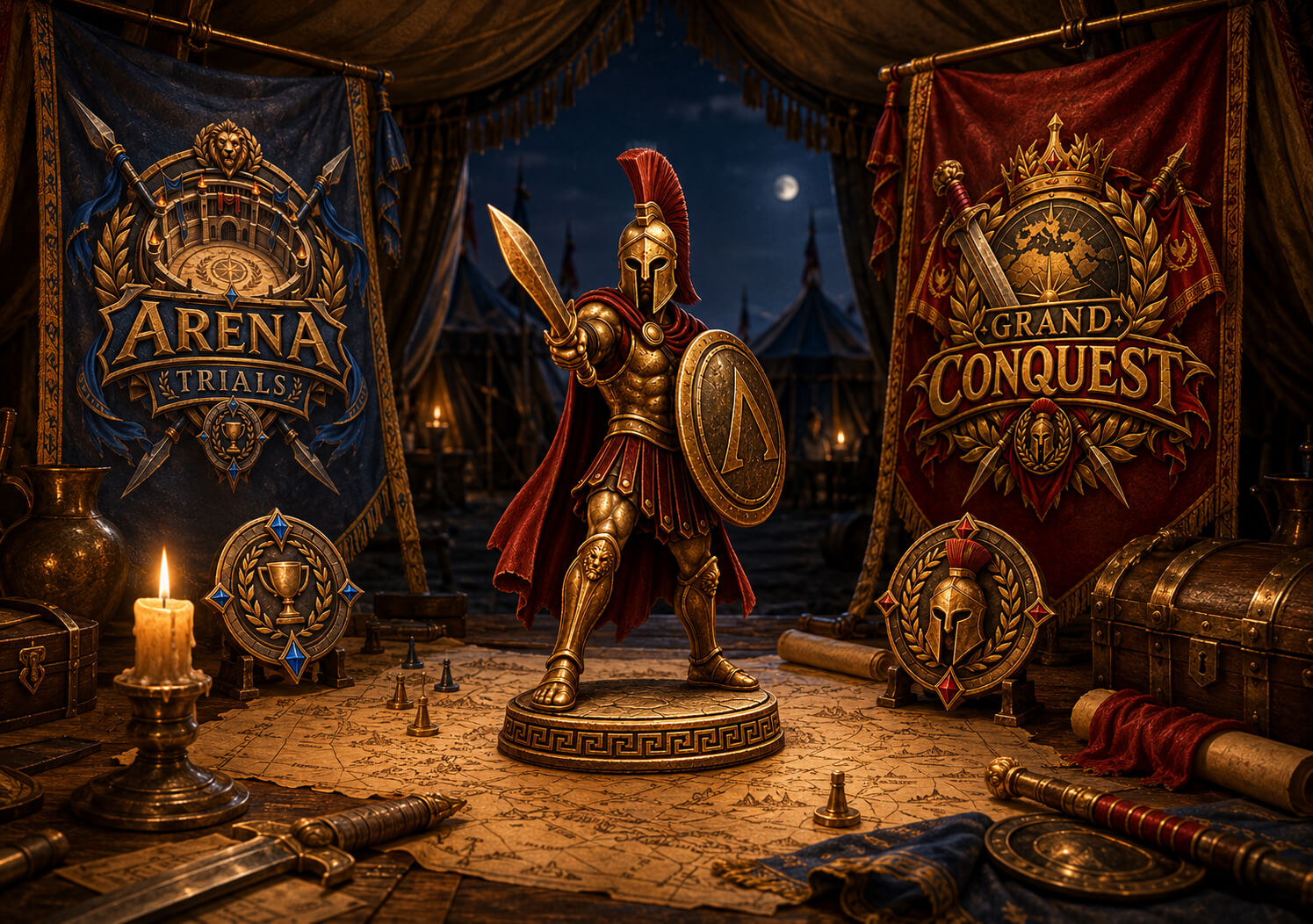
Ancient Duel has had competitive play since the ladder opened. Ranked answers one question well: how good are you today, against whoever else is online. Tournaments ask a different one. They ask what you can do when the matches are joined to each other — when a loss in the second round still has later rounds to answer for it, and when the thing you walk away with is a placement rather than a rating.
That is the whole reason tournaments exist here as their own layer rather than as Ranked with a prize attached. This article is the system as it stands: the two formats, how Championship Points work, how a season strings events together, and where all of it sits beside the ladder you already play. Tournament Credits get a short section and a link, because they already have an article of their own.
Why tournaments are not just a longer Ranked session
Ranked is continuous. You queue when you have twenty minutes, you play someone near your rating, and the result moves a number. That is a good shape for regular competitive play, and nothing here replaces it.
What continuous matchmaking cannot give you is a run. In a tournament the field is fixed at the start, everyone enters the same structured event, and each result changes what comes next. A strong opening puts you against the other strong openings. A stumble drops you into a group you can still climb out of. By the end the standings are not a snapshot of your form, they are the record of one event that had a beginning and an end.
That difference produces the things a ladder cannot: a defined start, opponents chosen by how the event has gone rather than by rating alone, and a finish that means something because everyone reached it the same way.
Where tournaments live
Tournaments have their own screen. The lobby is for choosing how to play; the Tournament Hub is for competing, and it is reached from the Tournaments game mode rather than crowding the lobby with brackets and balances.
The Hub is where the competitive side gathers: the formats currently open, how full each field is, your registration if you hold one, your Championship Points and your Credit balance, the standings of an event you are playing, and the record of the tournaments you have finished. When an event is under way and it is your turn, the Hub is also where you go to play the match.
Arena Trials
Arena Trials are the recurring format — the tournament you can expect to find rather than the one you wait for. A trial seats sixteen players and runs four Swiss rounds, which is enough for the field to sort itself without asking for a whole evening.
Swiss is the point. Nobody is eliminated. Losing your first match does not end your day, it changes who you play next, and the rounds that follow are against people whose event has gone about as well as yours. You keep playing to the end regardless of how it started, and the last round still matters.
A trial fills by registration rather than by schedule: when the field is complete, the event begins. Several can run at once, and when one fills the next opens, so joining is a question of taking a seat rather than of being awake at the right hour.
Arena Trials are also the ordinary road to Championship Points. Placing well in one is how most players will accumulate them, which makes the recurring format the foundation of the whole competitive season rather than a warm-up for something else.
Grand Conquest
Grand Conquest is the larger event. Thirty-two players, five Swiss rounds, and then a cut: the top eight go into a single-elimination bracket, quarter-finals through to a final, with a third-place match played rather than awarded on a tiebreak.
The two phases do different jobs. The Swiss seeds the bracket — five rounds is enough to establish who has actually played well, and everyone gets those five rounds whatever happens in them. The bracket then settles it, and settles it the way a final should be settled, by winning the match in front of you.
Entry is by Championship Points, which is what separates Grand Conquest from every other queue in the game. Points cannot be bought, so the field is not the players who paid, it is the players who earned their way in. That distinction is intentional: qualification for Ancient Duel's flagship competitive event is earned through performance.
Nothing about the system assumes one Grand Conquest, ever. It is built to run several over time, and to run more than one at once should the community reach the size that needs it.
Championship Points
Championship Points (CP) are the record of what you have done in competition. They are earned two ways: by placing in Arena Trials, and by reaching rating milestones on the seasonal ladder. Both are performances. Neither is a purchase.
This is the distinction worth being careful about, because the game has two competitive resources and they are not interchangeable:
- Championship Points measure competitive progress. They are earned by playing well, they cannot be bought, transferred or traded, and they are what qualifies you for Grand Conquest.
- Tournament Credits are the entry resource for events that ask for one. They are a separate system with its own rules, and they have nothing to say about how well you have played.
A Championship Point is closer to a qualification than to a coin. It says you finished somewhere or climbed to something. That is why there is no route anywhere in the game to buy one, and why the Hub, when you are short of them, tells you how to earn more rather than offering to sell you the difference.
CP you have earned stay on your account. A new season does not clear the balance — what a new season reopens is the ladder milestones, so the climb can be made again and pay again. Your total carries forward; only the seasonal milestone eligibility resets.
A season is more than one event
A competitive season is not a single tournament with everything riding on it. It is a stretch of time containing many Arena Trials, one or more Grand Conquest events, and the Championship Points that accumulate across all of them.
That shape matters for a practical reason. If the season were one event, missing it would mean missing the season, and every player who could not make a particular evening would be out of the competition entirely. Because progression accumulates across events instead, a run of trials over several weeks counts for as much as being free on the right night — and a bad result in one is something later events can answer.
It also means the ecosystem can grow with the number of people playing it. More players means more trials running side by side, not a longer queue for the same one.
Ranked and tournaments, side by side
These are two ways to compete, not a replacement and the thing it replaced.
- Ranked is continuous. Queue whenever you like, play one match, move your rating. It is the natural place to test a deck, learn a matchup, and climb — and the seasonal ladder is itself a source of Championship Points.
- Tournaments are structured. You register, the field fills, and you play a structured run of rounds against opponents whose results increasingly resemble your own, for a placement and for Championship Points.
Most competitive players will want both. Ranked is where preparation happens and where form is built; a tournament is where it is spent. Tournament results sit in their own standings and do not disturb your ladder rating, so entering an event costs you nothing on the ladder you have been climbing.
One account, whichever device you play on
Tournament play is not tied to where you installed the game. Ancient Duel runs in the browser, on desktop, on mobile, and on a television with a controller, and tournament participation is available wherever the game is — the same account, the same events, the same standings.
One distinction is worth stating clearly because it is easy to assume otherwise: Credits can be used on any supported device, but they are bought only through the Ancient Duel website. Nothing is purchased through a device's own store. If you are playing on a packaged build, the game will point you to the web rather than pretending otherwise.
Where Tournament Credits fit
Some events ask for Tournament Credits to enter. Credits are earned by playing and can also be bought; they unlock things that sit around the game, never power inside a duel.
They are not Championship Points and they do not overlap: Credits open a door, CP show you earned the right to walk through it. Arena Trials are entered with Tournament Credits; Grand Conquest is entered by qualification.
That is as much as this article needs to say about them. For the full account — what a Credit is, every way one can be earned, what they buy, and why they can never become money — read Credits, Rewards and Competition.
What tournament play actually asks of you
A tournament tests something a single match does not. One duel can be won by a good draw. Four or five in a row, against opponents who are doing about as well as you are, tends to be won by the player who prepared better.
In practice that means thinking about consistency over ceiling — a deck that wins convincingly one game in three is a worse tournament deck than one that is merely solid every time. It means knowing your faction well enough to play it when the draw is poor, and knowing the others well enough to recognise what you are up against by the second turn. It means managing risk across a run rather than a match, since a reckless line that occasionally pays off but fails more often than it succeeds is a losing line across a tournament run.
None of that is a separate ruleset. Tournaments use the same cards, the same factions and the same rules as every other duel. What changes is the horizon you are playing against.
Room to grow
Arena Trials and Grand Conquest are Ancient Duel's current tournament formats, and the system was deliberately not built around only those two. Formats are configuration rather than hard-coded assumptions: field size, round count, whether there is a bracket, what rewards a placement grants. Additional competitive formats can be added as Ancient Duel grows, without rebuilding the competitive layer around them.
The same is true of scale. Several events of the same format can run at once, and the Hub is built to show a season with many of them in it rather than a single scheduled fixture.
Where to start
If you have not played competitively yet, start on the Ranked ladder. It is where you will learn your deck, and the ladder itself earns Championship Points as your seasonal rating climbs.
When you want the other kind of competition — the kind with a field, a run of rounds and a placement at the end — open the Tournament Hub, take a seat in an Arena Trial, and see how far the run takes you.
Daniel Rusu
Creator & Developer of Ancient Duel